







Katherine Johnson: The Mathematician Behind Mercury, Gemini & Apollo

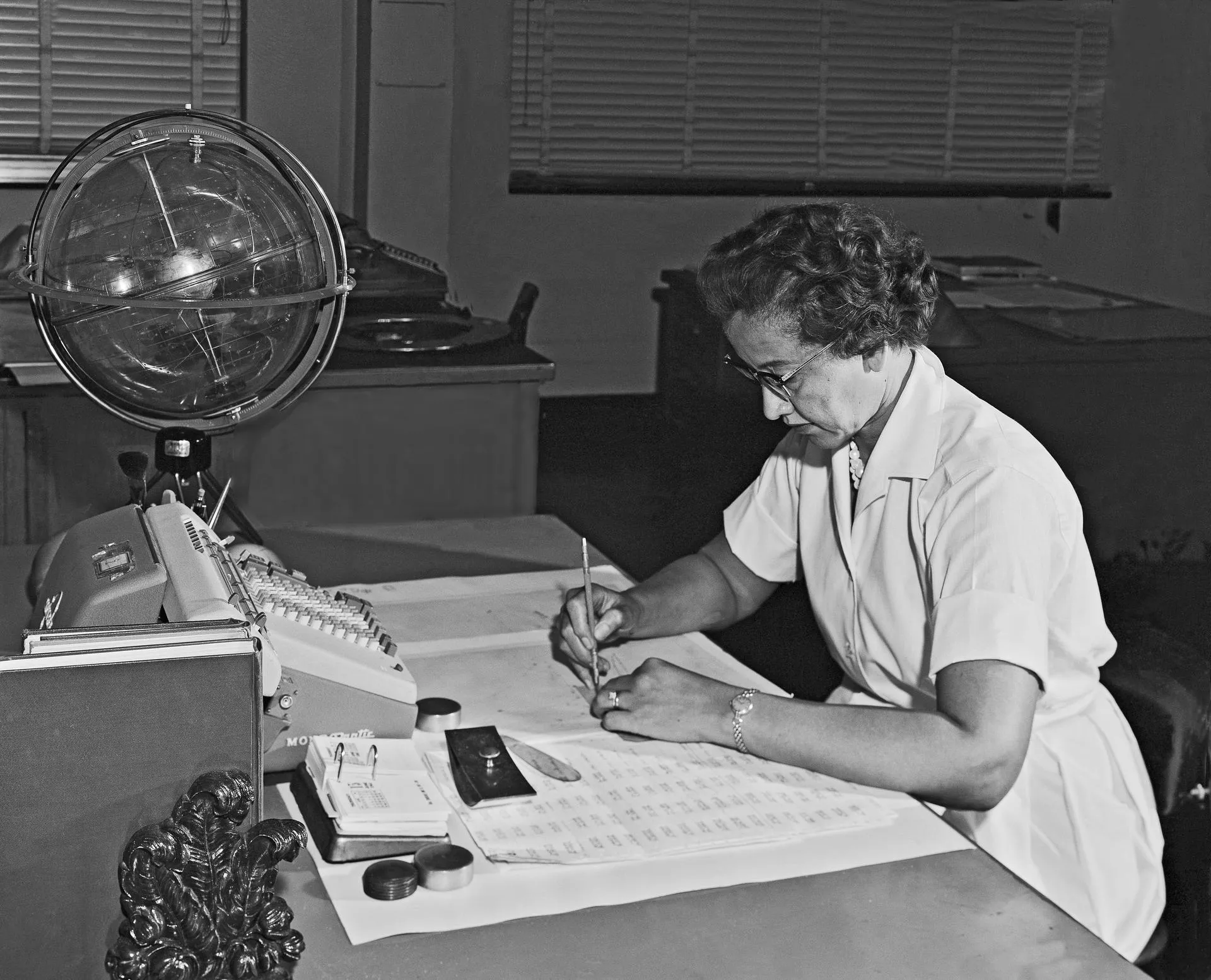
When thinking of groundbreaking women in tech, I instantly thought of the amazing story of Katherine Johnson. Born in 1918, Katherine was a NASA mathematician who calculated and analyzed the flight paths of many missions during her 30 year tenure in the U.S. space program. Her life story was recently made popular by the movie Hidden Figures.
Katherine Johnson had a brilliant mind from her childhood, attending high school at age 10, and graduating with high honors from West Virginia State College, earning bachelor degrees in Mathematics and French.
After graduating, she started teaching due to the lack of opportunities for women of color during the 1950’s, but in 1953 she began working at the National Advisory Committee for Aeronautics (NACA)‘s West Area Computing unit — a group of African American women who manually computed complex mathematical calculations for the program’s engineers. This was at a time where NACA was segregated, and the West Computers had to use separate bathrooms and dining facilities.
Despite starting her career at a time where women’s work, especially black women’s work, wasn’t seen as equal to men’s, Katherine made a lasting mark on the NACA program. She played an important role in NASA’s Mercury program, calculated the path for the spacecraft that put the first U.S. astronaut in space, verified the path for John Glenn’s orbit around the Earth, and helped calculate where and when to launch Apollo 11. She retired from NASA in 1986.
This March during Women’s History Month, here at Atomic Robot we are putting a spotlight on women in technology. While Katherine Johnson didn’t code software or design a computer, she was undoubtedly a pioneer in the world of tech. Her brain itself was a manual computer for some of the U.S.’s most important space missions and has made a lasting legacy — NASA renamed a facility in her honor, now calling it the “Katherine G. Johnson Computational Research Facility”.
While we no longer work in segregated facilities, and men and women can apply for the same jobs, the lesson of Katherine Johnson is still important today. Her story went unheard for decades, due to the environment of her time. Let’s all work toward giving women, and especially women of color, the recognition and opportunities that they deserve. Let us all work towards a future where no woman’s story is hidden, and all figures are appreciated for the value they bring.